Archive for category Self Development
Full Moon/SuperMoon ~ July 22, 2013 ~ in Aquarius, Sun in Leo
Posted by Doctapaul in Astrology, Astronomy, Healing, Love, Mindfulness, Personal, Self Development, Soundbytes of Wisdom, Tarot, Tip for the Day, Visions and Dreams on July 21, 2013

Contemplate service and the satisfaction from giving. What have you done, since the last Full Moon, for the greater good without asking for anything in return?
What could you do more of or differently?
Commit to two actions. When you complete the first, commit to a further action. Keep two action steps in front of you always – so you know where you are going.
What is really good for you is good for all.
Shine on…!
/|\
Paul C Burr
The Game of Life
Posted by Doctapaul in Astrology, Healing, Life's Changes, Love, Mindfulness, Personal, Pitfalls I've Fallen Into, Poetry, Relationships, Self Development, Soundbytes of Wisdom, Tarot, Tip for the Day, Visions and Dreams on July 20, 2013
Extract from Quick Guide IV – A Scorecard that Accounts for Mindfulness in Business.
Adapted from Druid wisdom (ref: Light and Life, a series of booklets written by David Loxley, Chief Druid, The Druid Order, London).
Your purpose is more than to succeed. It is to learn and apply the wisdom needed to succeed.
Success is the goal, but life is the time and space that happens in between now and reaching that goal. You attract the future that comes towards you. The future presents you with what remains incomplete right now in your life. The future presents the present with the opportunity to learn about yourself, incomplete wisdom, and apply that wisdom – completeness.Should you complete what is incomplete, it travels into the past and need not return.
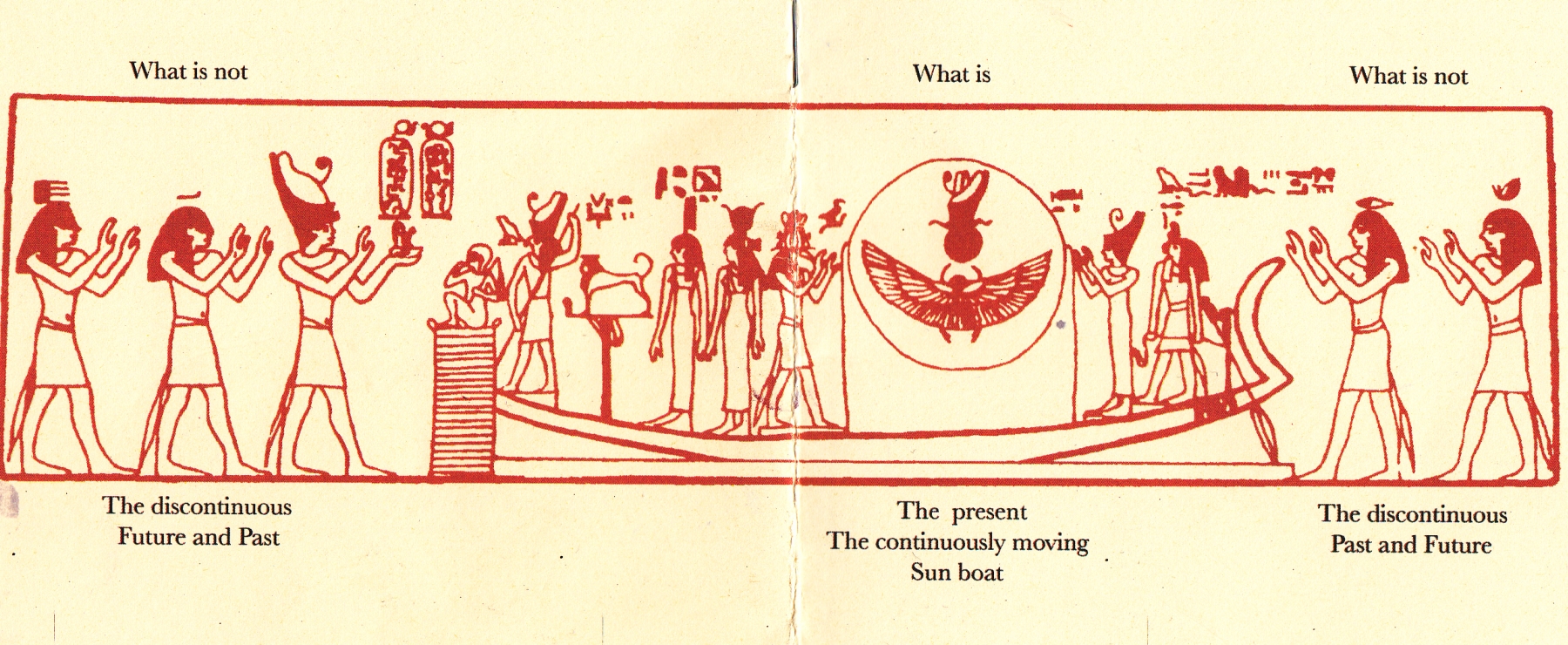
The Game of Life was understood by the Egyptians from the Ancient Kingdom.
Whatever travels into the past that remains incomplete ‘returns to the future’. Whatever issues (i.e. unlearned or unapplied wisdom) that remain incomplete, be they business or personal, return again and again until you complete them.
When you start something, complete it.
Shine on…!
/|\
Paul C Burr
Business/Personal Performance Coach & Author
Follow @paulburr
How to Be at your Peak in Every Key Meeting
Posted by Doctapaul in Business, Coaching, Leadership, Marketing, Mindfulness, Personal, Pitfalls I've Fallen Into, Quirky Ideas, Relationships, Self Development, Selling, Soundbytes of Wisdom, Tip for the Day, Training & Development, Uncategorized on July 15, 2013
 Extract from Quick Guide IV – A Scorecard that Accounts for Mindfulness in Business
Top performers do three essential things to be at their peak.
1. Clarify your outcomes for the meeting in hand and how you want the relationship with the person to develop, meeting by meeting, one step at a time. Moderate performers focus less on the latter dimension.
2. Be mindful of the frame of the mind you want to be in and that any meeting (is hopefully a meeting of minds) is ultimately about helping everyone present to frame a congruent viewpoint of what needs to be done.
3. Prepare your strategy, primarily so that you allow yourself to get in the frame of mind you want to be.
Research I’ve come across and my own experience shows that the most important thing you take into a meeting is your frame of mind followed by being clear about the outcomes you seek. Having a strategy is important but, once the meeting has started, it’s factors ‘2’ and ‘1’ above (and in that order) that will determine most how you ‘handle any curve balls thrown your way’.
Shine on…!
/|\
Paul C Burr
Business/Personal Performance Coach & Author
Follow @paulburr
“I Feel Good, dah-dah dah-dah dah-dah-dah!”
Posted by Doctapaul in Affirmations, Coaching, Healing, Leadership, Life's Changes, Mindfulness, Personal, Pitfalls I've Fallen Into, Quirky Ideas, Self Development, Selling, Soundbytes of Wisdom, Tip for the Day, Training & Development on July 11, 2013

Your outlook in life goes hand in hand with your personality. Personality is a long term habit. A habit is a long term mood. A mood is a long term feeling. So when you feel good and stay feeling good, you shape your outlook for the better. Do and say what feels good. If what you’re about to do doesn’t feel good, don’t do it!
Shine on…!
/|\
Paul C Burr
Business/Personal Performance Coach & Author
Follow @paulburr
Image courtesy of Fans Share
Effectiveness = Motivation x Confidence x Competence x Curiosity (Mindfulness in Business Meetings)
Posted by Doctapaul in book, Business, Coaching, Leadership, Marketing, Mindfulness, Quirky Ideas, Relationships, Self Development, Selling, Tip for the Day, Training & Development on June 20, 2013
 Extract from Quick Guide II: How to Spot, Mimic and Become a Top Salesperson

Most sales training I’ve come across focuses primarily on developing a salesperson’s skills or competencies, for example: opening, qualifying, questioning, advocating, presenting, negotiating and closing. The intention is that, over time with experience, the salesperson will get better and better at demonstrating these skills. It follows logically that they’ll become more confident in their sales approach and thus hopefully more motivated.
I haven’t seen much in the way of material that focuses on engendering an ongoing sense of curiosity, for example, how can I be the best, if not better, at what I sell?
The E=MC3 equation implies that an individual’s effectiveness is three parts mental and emotional (motivation, competence and curiosity) to one part intellectual (competence).
Let’s take a first pass at each of the qualities: motivation, confidence, competence and curiosity.
Motivation
Most salespeople are motivated to win, especially when the selling is relatively easy. Likewise, most are motivated by earnings and win bonuses. Some are motivated by advancing their career.
What motivates top salespeople? The answers from my research fall into three categories:
1. “To be the best I can be” or “…recognised as the best salesperson there is” – not only the best in terms of results but the best at selling too (outcomes + journey).
2. “To deliver customer value above and beyond that expected.”
3. “To create a legacy so that I am renowned for the value I bring to customers and my organisation’s business.”
In all three categories, the top performers are motivated by being (and being seen as) excellent. ‘Moderates’ talk of winning and earnings but talk less of personal excellence.
Confidence
I worked with a 26 year old CEO of a recruitment firm who had a good reputation for hiring confident as opposed to arrogant people. I was asked to model how he went about the task. Our conversation went something like this:
Me: “How do you differentiate between a confident person and an arrogant one?”
CEO: “Well, I’m not sure; I just get a ‘feeling’.”
Me: “Describe that ‘feeling’.”
CEO: “Well you just sort of know, don’t you? It’s something you sense….. a gut feeling.”
Me: “Okay, imagine you have an arrogant person to your left and a confident to your right. What’s the difference between them?”
CEO: “The confident person asks questions; the arrogant person doesn’t. The confident person probes for where they feel they’ll bring value to the organisation. They look to find out if they will enjoy the role. They seek opportunities for themselves to grow in the role. The arrogant person takes a position that they have the knowledge and wisdom suitable for the job and makes no effort to see how well they’ll fit in.”
Top salespeople exude confidence by the quality of questions they ask as well as the articulacy by which they convey reassurance. (For a framework with which to construct quality sales questions, refer to the INCREASETM model in Number 1 of this series of business guides, Quick Guide – How Top Salespeople Sell.)
Competence
If you stacked all the sales training and development materials in the world on top of one another, you’d probably build a mountain higher than Mount Everest. So I’ll attempt to put a different slant on competence by giving you a customer’s perspective. (For completeness, Appendix 1 lists the skills and knowledge demonstrated by top salespeople at, and away from, the customer interface.)
A corporate salesperson spends, on average, 15% of their time speaking directly to a customer. Ergo, 85% of the time, they apply their skills and knowledge to researching, developing and planning; how to be more effective during the ‘15%’ customer interface window when the occasion arises.
Top performers prepare themselves, intellectually and psychologically, to be at their peak when speaking to the customer. They develop appropriate skills and knowledge (the intellectual exchange) and they also prepare themselves to be in the right frame of mind and body (the mental and emotional exchange) with the customer.
Being perceived as ‘competent’ by the customer requires you to be:
1. Prepared: with insightful questions to ask and have answers to potential customer questions, including facts, data and logic so that your proposals are visionary, ‘grounded in reality’ and hopefully compelling
2. Clear about the outcomes: What do you want to achieve in the meeting both in terms of the task-in-hand and your relationship with the customer (e.g. engender trust). It’s also being very clear about the outcomes the customer might want to achieve, in terms of their task-in-hand and from their relationship with a supplier like you.
Illustration: 4 Outcomes to a Meeting
 Most of us prepare ‘box 1’ before a meeting. Many ‘moderates’ omit boxes 2 and 3 above from their preparatory work. Most salespeople miss out box 4 altogether – often because of a lack of self-belief and sometimes unconsciously. They don’t visualise themselves in a picture working closely with the customer.
3. In the right frame of mind: If you were to prioritise the three factors: Prepared, Clear Outcomes and Frame of Mind – which order would you place them?
Exercise: Allocate three weighting percentages (that add up to 100%) against Prepared, Clear Outcomes and Frame of Mind respectively – in terms of how important they are to being successful during (not before) a meeting.
Research shows…
The most important thing you take into a meeting is your frame of mind.
Be Mindful!
This statement often raises a few queries. It doesn’t say that you shouldn’t prepare diligently for a meeting. What it says instead is – the moment the meeting starts, the single most important factor that will determine your success is your frame of mind. You may well feel you have to do a significant amount of preparation to get yourself ‘centred’, for example. BUT it’s not the process the meeting follows that determines success the most; it’s you, your frame of mind and the thoughts that engender that frame of mind.
Specifically, whatever thought you process in your conscious mind passes straight into your unconscious mind and merges with any ‘subconscious programmes’ running there. The aggregate information is then passed directly to your DNA which vibrates at different rates in accord with your temperament. That is:
The vibe you put out determines your success.
I coached a very successful salesperson who never felt at her best in front of a CEO customer. It took a wee while for us to discover a subconscious programme she’d developed from her authoritarian parents, created by a ‘single significant emotional event’ when she was three years old. Once she ‘released’ this programme, her faith-in-self in front of CEO’s increased significantly. Her sales soared.
Research by scientists (e.g. The Biology of Belief, by Dr Bruce Lipton and The Genie in your Genes, by Dr Matthew Dawson) demonstrates the subliminal communicative functioning power of DNA between human beings which can be harmonious (I prefer the term, ‘resonant’) or out of tune (dissonant) – and at its extreme, disruptive.
Allow me to define ‘being competent’ as not only having the capability to demonstrate requisite skills and knowledge at the customer interface, it’s also about being competent at preparing yourself to be at your peak, to achieve the gravitas (sometimes called ‘traction’) you seek.
Author’s note: gravitas is something we can all achieve; it’s a result not a gift privy to a chosen few. Only 15% or so of salespeople achieve the ‘customer gravitas’ they seek, hence this book!
Let me add, the competence that customers attribute to you will also include an element of the perceived competence of the solutions you bring to the table, i.e. an acknowledgement of the potential of your solution’s value proposition. Put another way, if the customer has little faith in what you’re selling, even though they value your personal contribution, to what degree will you be invited to participate in the decision making process?
We’ve covered two of the three ‘Cs’ in the E=MC3 equation. A salesperson not only has to be competent in following ‘top sales processes’ (and have potentially ‘competent’ solutions); they need to be confident in their ability and motivated to follow those sales processes too. And still there’s one further factor that determines how effective you are (by seeing what’s really going on), a heightened sense of…
Curiosity
Top salespeople are unstintingly curious. For example, they love to be coached. They are very willing to learn how to become more effective at selling.
Top performers focus on working smarter, not harder, than ‘moderates’
You might ask, “Curious about what?” Answer: “Everything!”
Top salespeople probe below the surface of what’s going on – especially when forging business relationships. Like a metaphorical iceberg, they acknowledge that you only see about 15% above the surface; the obvious facts and logic by which a customer makes a decision. But they don’t stop there, they’re proactive to find the real passions and fears which will motivate or deter key stakeholders in the decision making process.
Curiosity is the sonar signal you emit to track changes on your ‘sales radar screen’. You track political, economic, sociological, technological and organisational developments as well as your competitors’ manoeuvres. At the deepest level, you’re tuning into changes in customers’ feelings, e.g. inspiration, motivation, confidence, sense of security, anger and most of all – trust and fear.
There’s more. You also need to be proactively curious about what might happen. I return to this later.
To summarise: selling is three parts mental/emotional to one part intellectual.
E=MC3, it’s not rocket science!
Shine on…!
/|\
Paul C Burr
Business/Personal Performance Coach & Author
Share this blog…


Quick Guides to Business – new page created
Posted by Doctapaul in Business, Coaching, Leadership, Marketing, Quirky Ideas, Relationships, Self Development, Selling, Soundbytes of Wisdom, Training & Development on June 20, 2013
I’ve released a new page in this website devoted to the Quick Guides to Business I’m writing. It will contain links to extracts that you will hopefully find interesting and helpful.
Your feedback about Quick Guides to Business or any aspect of this site would be most welcome.


Shine on…!
/|\
Paul C Burr
Business/Personal Performance Coach & Author
Follow @paulburr
The Decisions You Make, Are They Borne of Love or Fear?
Posted by Doctapaul in book, Healing, Life's Changes, Love, Personal, Pitfalls I've Fallen Into, Quirky Ideas, Relationships, Self Development, Soundbytes of Wisdom, Tarot, Tip for the Day, Uncategorized, Visions and Dreams on June 4, 2013
“We change the map of life itself by changing our attitude towards it.”
from The Mind of the Druid by E G Howe
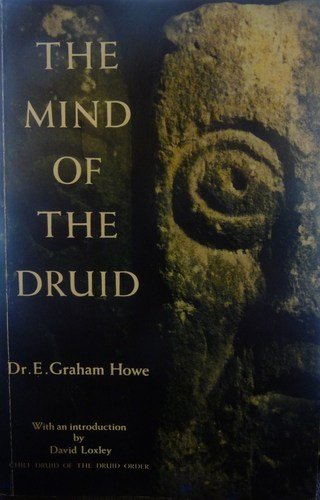
(Probably the most profound book I’ve ever read. I’ve read it 4 times and I’m still trying to ‘get it!’)
Shine on…!
/|\
Paul C Burr
Successful Business Relationships: The Logic, Premium and Legacy
Posted by Doctapaul in Business, Coaching, Leadership, Marketing, Personal, Pitfalls I've Fallen Into, Quirky Ideas, Relationships, Self Development, Selling, Soundbytes of Wisdom, Tip for the Day, Training & Development, Visions and Dreams on May 30, 2013
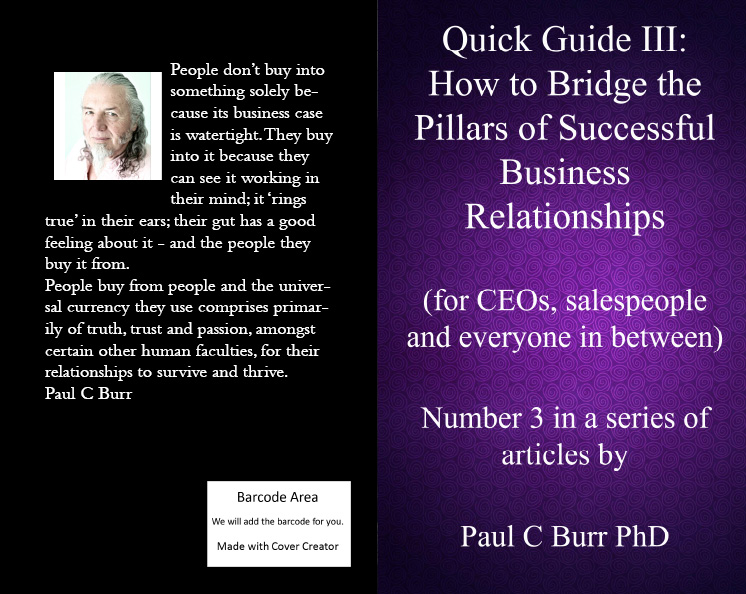
 My latest booklet, Quick Guide III – How to Bridge the Pillars of Successful Relationships (QG3), focuses on complex, inter- and intra- corporate, many-people-to-many-people, business relationships.
There are sound, logical, rewarding, tangible and emotional reasons for building healthy relationships. These very same reasons apply equally to personal relationships.
Here’s an extract from QG3…
Logic – less cost
Research shows that once you’ve established a customer relationship based on mutual trust and value, it takes five times the effort to build the same relationship with a new customer as it does to maintain it with your current customer.
When the cost of new prospect sales is five times that of existing satisfied customer sales, you don’t need a certificate in mathematics to appreciate the importance of satisfying, if not exceeding, the expectations of existing customers irrespective of the premium you earn from brand loyalty.
Premium – higher earnings
A reputable brand image makes selling a lot easier. I had no problem whatsoever getting to see new clients when I worked for IBM. Cold-calling for an organisation that isn’t a ‘household’ name, however, was a real ‘eye-opener’ for me after I made the switch.
The value of your reputation is the premium that customers will pay to do business with you over and above what they will pay your competitors, all else being equal, plus the cost reduction in sales your brand reputation affords you.
A simple example: ‘Household-name’, supplier A, renowned for its high quality products and services, sells a PC. ‘Relatively-unknown’ supplier, B, clones A’s PC with the exact same components, guarantees and terms of service. Intrinsically there’s no difference between PCs from either supplier. The cost of production and distribution of each product is the same.
Look at the buying/selling process from a customer perspective. All else being equal…
- What price difference will a customer pay (for the increased: reassurance, sense of status or another emotional, differential source of value they feel) for a PC from supplier A over supplier B?
- Reduction in sales cycle time and resourcing: how quicker and easier is it for a seller to convince a customer of the quality of a PC from supplier A compared with supplier B?
Brand value = [(what customers pay you) – (what customers pay for the exact same product/service from your competitors)] + (increase in productivity/cost-reduction in sales afforded by your brand)
Legacy – higher contribution
How do you want to look back on your time in sales and management at the end of your career? How do you want to be remembered? As a seller, buyer or leader: do you want to feel you’ve kept (or at least strived to keep) the agreements you made?
Maybe a business world forged with 100% truthful relationships is somewhat of a pipe dream, but as you look at the world’s economy and the ‘wars’ for limited resources right now, what choice do we have? And we have to imagine something before necessity will mother its invention – do we not?
‘You’ can either contribute to a world where wealth and power are shared through equitable negotiation – or not, truth or illusion/deception, abundance or scarcity, oneness or separateness, love or fear. ‘You’ choose! (But this is the topic contained in another book of mine, Defrag your Soul.)
Shine on…!
/|\
Paul C Burr
The Currency of All Relationships: Truth, Trust and Passion
Posted by Doctapaul in Business, Coaching, Healing, Leadership, Love, Marketing, Personal, Pitfalls I've Fallen Into, Relationships, Self Development, Selling, Soundbytes of Wisdom, Tip for the Day, Training & Development on May 28, 2013
It’s Out! Quick Guide II – How to Spot, Mimic and Become a Top Salesperson.
Posted by Doctapaul in Business, Coaching, Leadership, Marketing, Self Development, Selling, Training & Development on May 8, 2013
Available from Amazon in US, UK and Smashwords in Kindle, paperback and e-book versions.
Publication Date: May 6, 2013 | Series: Quick Guides to Business
Over and above exemplary sales achievements how do ‘you’ (by ‘you’ I mean: you, me, us, we) spot a top salesperson when you meet one? Top salespeople come across differently. There’s a resonance to their mannerisms. If you want to sell as well as they do, how would you go about it? If you were to ask the same questions and give the same answers as they do, would that be enough? No, because you bring your own personality and mannerisms into the equation. It requires the wisdom and will to nurture 7 key traits by which top salespeople outsell ‘moderates’.
This series of ‘Quick Guides to Business’ is borne of research, direct selling experiences and coaching in some of the world’s largest companies including: IBM, Xerox, Cisco, BP, American Express, Standard Chartered and Reckitt Benckiser.
From the Author
I chatted to two advisers about a business book that “I have inside me”. I had original research and experience inside my head. I had data. It delves into people’s effectiveness at strategic and personal levels. I’d developed simple but powerful business frameworks and a scorecard that take people’s feelings, motivations and fears into account.
They reveal what happens below the surface of successful business relationships at their outset – and what needs to happen for those relationships to thrive. I had a lot to tell but would the busy-business people, it’s aimed at, read it? So I tested my ideas and scope for ‘the book’ with two wise confidants.
The first simply said, “At last, I’ve been waiting for you to write ‘your business book’. When are you going to write it? I want a copy!”. The second: “People want ‘quick guides’ these days. They want ‘manageable chunks’ of wisdom, practical tools and ‘cheat sheets’. Something you can read in minutes and do something with straight away.”
Subsequently, I gave a series of briefings to business audiences and post-graduates. The talks were very highly received. The University of London asked me back to talk to a wider range of postgraduates in business-related studies. I am due to go back a third time.
March 2013: I set about writing a series of Quick Guides. Each would have about 10-15 (A4 size) pages of findings, tips, self-help tools and insights into specific topics.
The majority of my work focuses on what top performers do differently from ‘moderates’. I’ve started in sales and sales management, an area in which I’ve coached hundreds of individuals/teams and conducted research – across Europe, the Middle East and Asia.
The first two guides reveal ‘the what, how and why’ top salespeople outsell ‘moderates’. They sequence activities differently. They come across differently. They attune their approach to the most senior of clients resonantly; ‘moderates’ do not.
My next and third Quick Guide… will reveal what needs to happen for business relationships to thrive over the long term.
Summary Bullet Points
This 17-page article (A4 size, excluding appendices) bears from my research, consulting, direct selling and coaching within global corporations over a twenty year period.
Within you will discover how and why top salespeople succeed through:
- Effectiveness = motivation x confidence x competence x curiosity (or E=MC3)
- Migrating from selling at D-Level (middle management) to C-Level (senior management) involves a journey, from a tangible and known environment to one of uncertainty and the unknown
- Engaging a customer effectively and willingly, to co-explore uncertainty and the unknown, requires a salesperson to demonstrate 7 key traits, characteristics and competencies
- Faith-in-self
- Curiosity
- Composure
- Sensibility
- Co-opting
- Inspirational
- Passion
- Top salespeople demonstrate that:
- The aforementioned 7 key traits are what really differentiate top performers from ‘moderates’, more so than behaviours in that they predict whether the salesperson will be successful selling directly to C-level clients.
- You can spot a top-performer or high-potential individual by noticing how much they demonstrate these 7 key traits.
- These key traits are nurtured not ‘trained in the classroom’; the nurturing process can be accelerated by equipping yourself with ‘non-expert’ coaching tools, such as in Appendix 2 – Prepare to Be at your Peak in Every Meeting.
Shine on…!
/|\
Paul C Burr
Author of Quick Guide: How Top Salespeople Sell, Learn to Love and Be Loved in Return, 2012: a twist in the tail and Defrag your Soul
Follow @paulburr
Top Salespeople in the Future will Forge Truth…
Posted by Doctapaul in Business, Coaching, Current Affairs & The Economy, Leadership, Marketing, Self Development, Selling, Tip for the Day, Training & Development, Visions and Dreams on May 2, 2013
Extract from Quick Guide – How Top Salespeople Sell
Picture courtesy of Electronic Payments Coalition
 The higher up a corporate customer’s management hierarchy you call, the more uncertainty there is to deal with. At operational levels, you deal with business unit managers who, by and large, are all measured against the same tangible yardsticks of performance.
Once above that level you deal with leaders of change who, by definition, are looking to do things that haven’t been done before. They focus on defining and creating new realities. They are the ‘harbingers’ of tomorrow’s world.
The ‘harbingers’ delve into the unknown. Their task is becoming increasingly difficult because the unknown, aided and abetted by ever increasing changes in technology, is getting larger and darker. There’s much more data about what’s going on but can it be extrapolated with confidence into the future?
There is very little data that accurately measures what the world or business may look like in anything beyond six weeks hence.
I went to series of banking seminars in and around mid 2008. Were there ‘green shoots’ appearing in the economy? Were we in an elongated dip? Were we starting a ‘double dip’? Nobody could predict accurately. Any form of optimism was mooted very cautiously. More data was called for. More analyses were completed. Did they make any of the forecasts more believable? No. Bankers and politician’s couldn’t predict the future with any sense of accuracy. They/we still can’t.
We live with more data, more unknowns and more uncertainty than we ever have because the future happens a lot more quickly than it used to.
The more uncertainty faced, the more we need to put trust in our advisors and ourselves. But trust is not truth.
Trust is the gap between what we know and what we put our faith in.
Here lies the role for, dare I say, a ‘newish’ generation of salespeople. There was a biggish fad a few years ago to develop salespeople to become ‘trusted expert advisors’. My personal experience is that you can count on one hand the number of ‘broad-based industry experts’ in, for example, a global IT sales organisation who know as much about, say, banking as the bankers themselves. And even then you might find you have three or more of your fingers missing.
The new sales role is more than mentoring and different. The relationship with the customer still requires a huge amount of trust but the ‘new salesperson’ doesn’t need to be an industry expert. Instead, they develop the expertise to help explore uncertainty and find answers in the hidden nooks and crannies of the psyche of their customers’ organisation.
By psyche, I mean the intellectual and emotional capabilities of its leaders and workforce. These salespeople don’t have magical answers. Instead, they have magical questions that spark the customers imagination into collaboratively putting together a believable ‘image-in-ions’.
This is about making the sales/customer relationship equation: 1 + 1=3. The sum of the parts is more than each party can bring to the table on their own. But this is a relationship that transcends trust, it’s rooted in truth. There are no hidden agendas.
When you exchange truth with another wholly, you no longer need to trust them. What remains is your trust in yourself.
This is more than being an ‘honest broker’. The salesperson of the future will still bring skills and know-how of their own industry to the table. BUT, the top salesperson will be an intrepid explorer too; capable of guiding clients into the unknown and back again safely. They achieve this by knowing how to find and help release that which holds the client back, namely fear.
Only four things hold us back in life: shame, anger, sadness and fear. When you look inside these negative emotions, you discover they’re all fear. The opposite of truth is falsity. Behind all falsity lies fear.
The top salesperson earns the customer’s trust because they deal in truth, and only truth. Truth drives out falsity which ultimately releases fear. More than trust, truth forges a relationship that can connect to the ‘greater good’ for all involved.
A business world forged by relationships rooted in truth might be a pipe dream. But we have to imagine it before we can create it. As we look back over history and specifically the world economy over last few years, it begs the question, “What sustainable alternative do we have?”
Shine on…!
/|\
Paul C Burr
Author of Quick Guide: How Top Salespeople Sell, Learn to Love and Be Loved in Return, 2012: a twist in the tail and Defrag your Soul
Follow @paulburr
TftD: Changing your Character, Changes your Life
Posted by Doctapaul in Astrology, Coaching, Healing, Leadership, Life's Changes, Love, Personal, Pitfalls I've Fallen Into, Quirky Ideas, Relationships, Self Development, Selling, Soundbytes of Wisdom, Tip for the Day, Training & Development on April 5, 2013
 Image courtesy of Blaze Institute
…All that happens is the result of character; the only manner in which the destiny can be changed is to change the character…..
the chart of birth….is merely a map of character…..
(and) can be markedly altered in any direction desired.
CC Zain
Shine on…!
/|\
Paul C Burr
Author of Quick Guide: How Top Salespeople Sell, Learn to Love and Be Loved in Return, 2012: a twist in the tail and Defrag your Soul
What Does It Take to Coach a Top Executive or Performer?
Posted by Doctapaul in Business, Coaching, Leadership, Pitfalls I've Fallen Into, Self Development, Selling, Tip for the Day, Training & Development on April 5, 2013

Any form of business improvement, be it personal or strategic, is a journey, 2 parts emotional to one part intellectual.
I was a guest of Kevin Price, on the Price of Business radio talk-in show on Thursday, 28 March 2013.
What does it take to increase the effectiveness of someone who’s already the best (or at least very experienced) at what they do?
Shine on…!
/|\
Paul C Burr
Author of Quick Guide: How Top Salespeople Sell, Learn to Love and Be Loved in Return, 2012: a twist in the tail and Defrag your Soul
Follow @paulburr
TftD: The 4 Seeds of Negative Karma that Hold you Back
Posted by Doctapaul in Healing, Life's Changes, Love, Personal, Pitfalls I've Fallen Into, Relationships, Self Development, Soundbytes of Wisdom, Tip for the Day on April 3, 2013
Extract from Defrag your Soul….
Only four things hold you back from that which your heart truly desires….
1. Shame
There is no shame in failure but failure is endemic to shame.
2. Anger/Resentment
Resentment is like poisoning yourself whilst waiting for someone to die.
Better still,
Holding a grudge is letting someone live rent-free in your head.
Sourced from the Internet.
3. Sadness/Hurt
I’ve cried, and you’d think I’d be better for it, but the sadness just sleeps, and it stays in my spine the rest of my life.
Conor Oberst
4. Fear
F. E. A. R. = False expectations appearing real.
These four negative emotions serve a purpose. For example, when you have learned all you need to know about shame, you have readied yourself to appreciate not-shame – i.e. to feel good about yourself. To appreciate a high vibration fully, you need to know about its exact opposite.
Such is duality:
- Shame –> not-Shame –> e.g. feel okay, feel good, self compassion, caring for self, trusting self, self worth, self liking, self love, love
- Anger–>not-Anger–>e.g. composed, relaxed, fondness, love
- Sadness–>not-Sad–>e.g. joy, happiness, serenity, expansion, wisdom, love
- Fear–>not-Fear–>courage, faith, fearlessness, stillness, wisdom, love.
The opposites of all four seeds of negative karma lead ultimately to love. When you release shame, anger, sadness and fear, you journey towards love, borne of oneness, borne of the divine.
Where does life’s journey take me?
To truth, your truth, love, oneness, your divine self.
Duality: anything that is not truth, not love or not oneness is not divine.
Shine on…!
/|\
Paul C Burr
Author of Quick Guide: How Top Salespeople Sell, Learn to Love and Be Loved in Return, 2012: a twist in the tail and Defrag your Soul
Follow @paulburr
Quick Guide: How Top Salespeople Sell
Posted by Doctapaul in book, Business, Leadership, Marketing, Self Development, Selling, Training & Development on March 30, 2013
 Ebooklet – Quick Guide: How Top-performing Salespeople Sell – for new or seasoned sales professionals, managers and CEOs. You can now download this first in a forthcoming series of business articles from Smashwords.
Shine on…!
/|\
Paul C Burr
Author of Learn to Love and Be Loved in Return, 2012: a twist in the tail and Defrag your Soul
Follow @paulburr
TftD: Truth Goes Hand in Hand with Trust but Ultimately Surpasses It
Posted by Doctapaul in Coaching, Healing, Leadership, Life's Changes, Love, Personal, Pitfalls I've Fallen Into, Relationships, Self Development, Selling, Soundbytes of Wisdom, Tip for the Day on March 26, 2013

Honesty
Being honest often requires courage. And courage is about letting go of fear and trusting yourself.
Trust is the gap between what you know to be true and what you have faith in.
And truth drives out falsity.
Have faith in, and be true to, yourself (“above all else” as the Bard once said.)
Shine on…!
/|\
Paul C Burr
Author of Learn to Love and Be Loved in Return, 2012: a twist in the tail and Defrag your Soul
Follow @paulburr
Beowulf: Warrior, Magician & Therapist
Posted by Doctapaul in Healing, Myths, Personal, Pitfalls I've Fallen Into, Poetry, Self Development, Soundbytes of Wisdom, Tip for the Day, Visions and Dreams on March 23, 2013

Written some 1500 years ago, by an anonymous bard, Beowulf tells the story of a gallant hero who travels north to Denmark to slay the swamp beast, Grendel.
(Image: first page of Beowulf manuscript)
Grendel would visit the local King Hrothgar’s castle and set about killing all whom it encountered, carrying severed limbs and bodies back to its lair at the bottom of a deep dark lake.
Beowulf slays Grendel. That night there is much merriment and feasting, Beowulf and his men retire to a far part of the castle. A second creature enters the hall where many still celebrate. The creature, Grendel’s mother, the source of the problem, wreaks her revenge. Like Grendel, she retires to her lair and Beowulf sets off after her.
The presenting problem is never the real problem. The real problem lies behind all the presenting problems. When the real problem disappears, so do all of its presenting problems.
Beowulf approaches the edge of the lake. Below him in the deep dark abyss lies the beast in her lair. Before he descends there is great temptation to withhold and draw back but with courage – afforded by the finest sword, shield and armour – Beowulf steps forward and descends into the darkness, his darkness. Below, he and the beast engage in battle. He finds the magnificent sword, shield and armour – that protect him so well on the surface – serve no use in the darkness. Beowulf casts them off. He reveals his unprotected self, his complete vulnerability. Beowulf and the beast become one in combat and as they wrestle, Beowulf finds a luminous sword of light that hangs on the wall of the lair – a sword with which he slays the beast.
As Beowulf rises to the surface to reveal the beast’s head, he finds that the luminous sword dissolves. The luminous sword that worked in the darkness has no power in the known world. It leaves Beowulf unable to demonstrate its power. For others to understand the sword’s power, they must descend into darkness and find it for themselves. They must experience their own victory. They must choose courage.
We cannot stare at the sun in a noon-day cloudless sky.
Light cannot be seen in the light.
At midnight, the cloudless sky reveals infinity.
By clouds, I mean ‘clouds of emotion’ – shame, anger, sadness and fear.
Glory comes from our journey into the darkness.
Shine on…!
/|\
Paul C Burr
Author of Learn to Love and Be Loved in Return, 2012: a twist in the tail and Defrag your Soul
Follow @paulburr
Shame, Not-self-love, Is the First Step toward Mind Control
Posted by Doctapaul in Healing, Life's Changes, Love, Personal, Pitfalls I've Fallen Into, Relationships, Self Development, Soundbytes of Wisdom, Tip for the Day, Training & Development on March 21, 2013
 As a child I was taught to (do things that) please God and fear the Devil. By the age of 12, I allowed a cleric’s sermon to make me feel ashamed for all the ‘wrong’ things I did, thought and felt – like most young folk do, think and feel as they reach puberty. Much later I realised that guilt or shame is half of the ‘carrot and stick’ deal that parents, governments and some religions use to ‘control’ children, the populace and followers respectively.
Illustration by Andrea Kurucz
When you allow someone else to make you feel not good about yourself, you accede to their first step in mind control. Their intent is that you do their bidding, not your own.
To avoid mind control, you need to understand the nature of your own shame; you need to venture into your own ‘underworld’ to find the sources of that shame. Especially those things your parents did that made you feel ashamed as a child and perhaps hid away deep within you unknowingly.
You may not know consciously all the sources of shame you possess and may need some form of ‘plutonic’ awakening to unearth them. Shame is a gap between how you perceive you are and how you’d like to be. In my life I’ve been ashamed of being overweight, of hurting people but the deepest and most profound shame (that I’ve only recently discovered) was that I was not worthy of my parents’ love. And if I was not worthy of their love, I was not worthy of self-love. And if I was not worthy of self-love then I was worthy to love someone else – because I can’t give what I don’t possess. My shame stultified my capacity to love and be loved in return.
When you do something out of shame you may allay feeling that shame, but you never rid yourself of it. You can’t atone shame – but you can release it. You release shame by practicing self-forgiveness.
I’ve shared how my understanding of forgiveness has evolved in two previous blogs (Replace Forgiveness with Accountability and Client:-”I Can’t Forgive Myself.” – “You Don’t Need To.”).
In a nutshell:
Self-forgiveness is not about one part of you saying to another, “Even though you did wrongly I forgive you”. It’s about releasing all judgement.
Shame is a form of not-self-love that lives in your head, rent free. Self-forgiveness is allowing that not-self-love to leave completely.
When not-self-love leaves, all that remains is self-love; what’s in your head aligns with the love you hold in your heart.
You become love wholly.
You shine!
Shine on…!
/|\
Paul C Burr
Author of Learn to Love and Be Loved in Return, 2012: a twist in the tail and Defrag your Soul
Follow @paulburr
TftD: The Paradox of Joy and Hurt
Posted by Doctapaul in Healing, Life's Changes, Love, Pitfalls I've Fallen Into, Quirky Ideas, Relationships, Self Development, Soundbytes of Wisdom, Tip for the Day on March 20, 2013
 “The person who hurts you is often the person you run to, in order to feel better.”

Image sourced from Moments Count
Shine on…!
/|\
Paul C Burr
Author of Learn to Love and Be Loved in Return, 2012: a twist in the tail and Defrag your Soul
May ‘La Force’ Be With You
Posted by Doctapaul in Business, Coaching, Healing, Leadership, Life's Changes, Personal, Pitfalls I've Fallen Into, Self Development, Soundbytes of Wisdom, Tarot, Tip for the Day, Training & Development on March 19, 2013
Willpower + Commitment + Self Trust = Faith in Yourself
Slightly revised extract from Defrag your Soul
Hu-man did not invent the wheel, the steam engine, the aeroplane or the nuclear bomb without the capacity to imagine each invention in the first place – along with willpower, commitment and trust in its own ability to create such inventions. The same holds true for the future you seek for yourself.
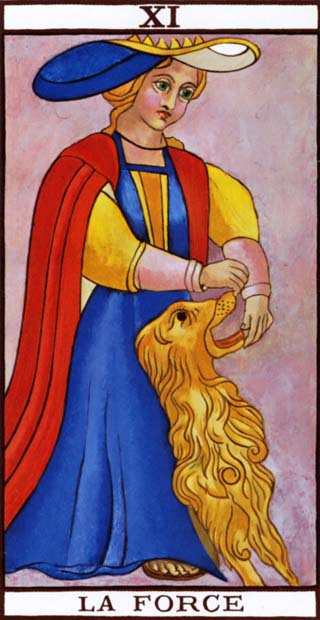 To invoke such ‘magic’ you need to perceive your ‘image-in-ions’ as highly desirable and have faith in yourself. You may find you need that faith in yourself for many other reasons:
The road can be long and hard.
I found thousands of ways how not to make a light bulb.
I only needed one way to make it work.
(Paraphrased from) Thomas Edison
You can meet many setbacks and stumbling blocks. Being a Leo, I’ve found affairs of the heart to be the biggest area of learning. The area, more than anywhere else, where in the past I have disowned facets about myself. Such setbacks and heartaches required a vast amount of patience with myself as well.
You may be ridiculed, ignored and isolated.
All truth passes through three stages. First, it is ridiculed. Second, it is violently opposed. Third, it is accepted as being self-evident.
Revolutionaries: Albert Einstein, Mahatma Gandhi, Oscar Wilde and Pink Floyd were all ridiculed either by their peers or the media before the world accepted the beauty and wisdom of their works.
When truth attempts to usurp not-truth, those protectors of not-truth in power often do all they can to suppress it; without bringing it or the truth tellers to the public’s attention.
Although I am a typical loner in my daily life, my awareness of belonging to the invisible community of those who strive for truth, beauty and justice has prevented me from feelings of isolation.
Albert Einstein
In my early years when I first got into spirituality, I was prone to be outwardly enthusiastic about my journey within. Most of the people around me were not into ‘it’ at all.
When, for instance at a wine party, I started spouting off about “shining light into my inner darkness”, I would get different types of response. The minority would show interest but the silent majority would remain quiet and walk away to join another group who talked about ‘normal’ things. Some who objected strongly to what I was saying would let me know of their views in no uncertain terms. Others would ridicule me face to face or behind my back. It is often easier to ridicule something than to face it; especially when that something invokes fear in you.
There’s a paradox too. If I’m attracting ridicule, is it because I fear it? Probably yes. In the meantime, I do my best to avoid responding to ridicule with ridicule or any other animalistic response. Sometimes I fail.
You may choose to isolate or distance yourself.
I go to the occasional reunion where others see changes in me. I no longer take much interest in ‘normal’ day-to-day small talk, like who is going to win ‘the current Saturday night TV contest’ or get thrown out of some ‘reality’ show. Many of my interests have changed and, perhaps more significantly, my perspective has changed.
For example, I feel distanced when people complain about being the victims of an economic recession that we have collectively created. At the same time, I ask myself, “Why have I attracted this conversation? I wonder where I am not being accountable for what I receive in life; whom or what am I blaming?”
I do not consider myself superior in any way and do my best not to come across as an evangelist. It’s that I’ve moved on. If people ask my opinion about the latest TV game show, I probably don’t have one. If we’re discussing global events, I speak my views.
I prefer to distance myself from day-to-day chatter or ‘complaining about the system’ – both of which I might have engaged in once upon a time.
I still ‘rabbit on’ a lot about two of my passions though: football and music (probably more than I do about spirituality J) and, undoubtedly, I distance a few people from myself in the process as well.
You may be opposed violently.
When all other attempts at their suppression fail, truth tellers face their sternest test; to stand firm and risk physical harm from those who stand to fall by truth. I could cite religious, political and civil-rights leaders, pacifists and innocent people – all whom have been attacked, beaten and some murdered ignominiously to prevent truth from being revealed to, or sustained in, the world.
What others do not do to you, you may do to yourself.
Without willpower, you limit the depth of your learning; you only go so far and you only get so much in return. When you commit yourself 100% to a project, that’s what you can receive in return, 100%. On the other hand, if you commit less than 100%, you get at best what you put into it and sometimes you get nothing. Ask any seasoned salesperson.
________________________________________
Act as if you make a difference. Act as if you count. Act as if and you will…
Notice the focus is on your journey, more than the outcome.
From Warrior to Magician
By Paul C Burr
Toward the flower in full bloom,
Full Truth in the noonday sun.
Devoid of ego, it casts no shadow.
With no nooks and crannies to hold darkness,
All it can now do is give of itself.
Unafraid of being cut down (crucified) by those, in power, who fear Truth.
The Warrior stands bereft of armour, sword and shield,
Secure in what they know is Truth.
No words of explanation required.
No fear to control or manage.
The darkness embraced.
The fear dissolved.
Armed with only Truth and compassion,
The Warrior thus becomes the Magician.
This is the way of the Tarot.
This is the true definition of White Magic.
Tis called redemption.
Shine on…!
/|\
Paul C Burr
Author of Learn to Love and Be Loved in Return, 2012: a twist in the tail and Defrag your Soul
Follow @paulburr
-
You are currently browsing the archives for the Self Development category.

Share this page
How to Be a Friend of the Devil Within

Available from Amazon and major bookstores:
Quick Guide VII – A Top-notch, Sales-Relationships, Account Management Template

Available from Amazon and major bookstores:
Quick Guide VI – How to Sell Coaching

Available from Amazon and major bookstores:
For The Love of Lilith & How to Put Love into Practice (and Non-attach Yourself to It)

Available from Amazon and major bookstores:
Quick Guide V – How to Apply Mindfulness to Business Relationships

Available from Amazon and major bookstores:
The Mystique to the Game of Life (and Unrequited Love)

Available from Amazon and major bookstores:
Quick Guide IV – A Scorecard that Accounts for Mindfulness in Business

Available from Amazon and major bookstores:
Quick Guide III – How to Bridge the Pillars of Successful Business Relationships

Available from Amazon and major bookstores:
Quick Guide II: How to Spot, Mimic and Become a Top Salesperson

Available from Amazon and major bookstores:
Quick Guide: How Top Salespeople Sell
Available from Amazon and major bookstores:
Defrag your Soul

2012: a twist in the tail

Available from Amazon and major bookstores:
Learn to Love and Be Loved in Return

Available in USA and UK, in paperback and Kindle format
 ,
, 
 ,
,  &
& 
 &
& 
 ,
,
 &
&
 also
also
 ,
,  also
also
 ,
, also
also
 ,
, 


 Paul C Burr