Archive for category Training & Development
What Does It Take to Coach a Top Executive or Performer?
Posted by Doctapaul in Business, Coaching, Leadership, Pitfalls I've Fallen Into, Self Development, Selling, Tip for the Day, Training & Development on April 5, 2013

Any form of business improvement, be it personal or strategic, is a journey, 2 parts emotional to one part intellectual.
I was a guest of Kevin Price, on the Price of Business radio talk-in show on Thursday, 28 March 2013.
What does it take to increase the effectiveness of someone who’s already the best (or at least very experienced) at what they do?
Shine on…!
/|\
Paul C Burr
Author of Quick Guide: How Top Salespeople Sell, Learn to Love and Be Loved in Return, 2012: a twist in the tail and Defrag your Soul
Follow @paulburr
Quick Guide: How Top Salespeople Sell
Posted by Doctapaul in book, Business, Leadership, Marketing, Self Development, Selling, Training & Development on March 30, 2013
 Ebooklet – Quick Guide: How Top-performing Salespeople Sell – for new or seasoned sales professionals, managers and CEOs. You can now download this first in a forthcoming series of business articles from Smashwords.
Shine on…!
/|\
Paul C Burr
Author of Learn to Love and Be Loved in Return, 2012: a twist in the tail and Defrag your Soul
Follow @paulburr
Shame, Not-self-love, Is the First Step toward Mind Control
Posted by Doctapaul in Healing, Life's Changes, Love, Personal, Pitfalls I've Fallen Into, Relationships, Self Development, Soundbytes of Wisdom, Tip for the Day, Training & Development on March 21, 2013
 As a child I was taught to (do things that) please God and fear the Devil. By the age of 12, I allowed a cleric’s sermon to make me feel ashamed for all the ‘wrong’ things I did, thought and felt – like most young folk do, think and feel as they reach puberty. Much later I realised that guilt or shame is half of the ‘carrot and stick’ deal that parents, governments and some religions use to ‘control’ children, the populace and followers respectively.
Illustration by Andrea Kurucz
When you allow someone else to make you feel not good about yourself, you accede to their first step in mind control. Their intent is that you do their bidding, not your own.
To avoid mind control, you need to understand the nature of your own shame; you need to venture into your own ‘underworld’ to find the sources of that shame. Especially those things your parents did that made you feel ashamed as a child and perhaps hid away deep within you unknowingly.
You may not know consciously all the sources of shame you possess and may need some form of ‘plutonic’ awakening to unearth them. Shame is a gap between how you perceive you are and how you’d like to be. In my life I’ve been ashamed of being overweight, of hurting people but the deepest and most profound shame (that I’ve only recently discovered) was that I was not worthy of my parents’ love. And if I was not worthy of their love, I was not worthy of self-love. And if I was not worthy of self-love then I was worthy to love someone else – because I can’t give what I don’t possess. My shame stultified my capacity to love and be loved in return.
When you do something out of shame you may allay feeling that shame, but you never rid yourself of it. You can’t atone shame – but you can release it. You release shame by practicing self-forgiveness.
I’ve shared how my understanding of forgiveness has evolved in two previous blogs (Replace Forgiveness with Accountability and Client:-”I Can’t Forgive Myself.” – “You Don’t Need To.”).
In a nutshell:
Self-forgiveness is not about one part of you saying to another, “Even though you did wrongly I forgive you”. It’s about releasing all judgement.
Shame is a form of not-self-love that lives in your head, rent free. Self-forgiveness is allowing that not-self-love to leave completely.
When not-self-love leaves, all that remains is self-love; what’s in your head aligns with the love you hold in your heart.
You become love wholly.
You shine!
Shine on…!
/|\
Paul C Burr
Author of Learn to Love and Be Loved in Return, 2012: a twist in the tail and Defrag your Soul
Follow @paulburr
May ‘La Force’ Be With You
Posted by Doctapaul in Business, Coaching, Healing, Leadership, Life's Changes, Personal, Pitfalls I've Fallen Into, Self Development, Soundbytes of Wisdom, Tarot, Tip for the Day, Training & Development on March 19, 2013
Willpower + Commitment + Self Trust = Faith in Yourself
Slightly revised extract from Defrag your Soul
Hu-man did not invent the wheel, the steam engine, the aeroplane or the nuclear bomb without the capacity to imagine each invention in the first place – along with willpower, commitment and trust in its own ability to create such inventions. The same holds true for the future you seek for yourself.
 To invoke such ‘magic’ you need to perceive your ‘image-in-ions’ as highly desirable and have faith in yourself. You may find you need that faith in yourself for many other reasons:
The road can be long and hard.
I found thousands of ways how not to make a light bulb.
I only needed one way to make it work.
(Paraphrased from) Thomas Edison
You can meet many setbacks and stumbling blocks. Being a Leo, I’ve found affairs of the heart to be the biggest area of learning. The area, more than anywhere else, where in the past I have disowned facets about myself. Such setbacks and heartaches required a vast amount of patience with myself as well.
You may be ridiculed, ignored and isolated.
All truth passes through three stages. First, it is ridiculed. Second, it is violently opposed. Third, it is accepted as being self-evident.
Revolutionaries: Albert Einstein, Mahatma Gandhi, Oscar Wilde and Pink Floyd were all ridiculed either by their peers or the media before the world accepted the beauty and wisdom of their works.
When truth attempts to usurp not-truth, those protectors of not-truth in power often do all they can to suppress it; without bringing it or the truth tellers to the public’s attention.
Although I am a typical loner in my daily life, my awareness of belonging to the invisible community of those who strive for truth, beauty and justice has prevented me from feelings of isolation.
Albert Einstein
In my early years when I first got into spirituality, I was prone to be outwardly enthusiastic about my journey within. Most of the people around me were not into ‘it’ at all.
When, for instance at a wine party, I started spouting off about “shining light into my inner darkness”, I would get different types of response. The minority would show interest but the silent majority would remain quiet and walk away to join another group who talked about ‘normal’ things. Some who objected strongly to what I was saying would let me know of their views in no uncertain terms. Others would ridicule me face to face or behind my back. It is often easier to ridicule something than to face it; especially when that something invokes fear in you.
There’s a paradox too. If I’m attracting ridicule, is it because I fear it? Probably yes. In the meantime, I do my best to avoid responding to ridicule with ridicule or any other animalistic response. Sometimes I fail.
You may choose to isolate or distance yourself.
I go to the occasional reunion where others see changes in me. I no longer take much interest in ‘normal’ day-to-day small talk, like who is going to win ‘the current Saturday night TV contest’ or get thrown out of some ‘reality’ show. Many of my interests have changed and, perhaps more significantly, my perspective has changed.
For example, I feel distanced when people complain about being the victims of an economic recession that we have collectively created. At the same time, I ask myself, “Why have I attracted this conversation? I wonder where I am not being accountable for what I receive in life; whom or what am I blaming?”
I do not consider myself superior in any way and do my best not to come across as an evangelist. It’s that I’ve moved on. If people ask my opinion about the latest TV game show, I probably don’t have one. If we’re discussing global events, I speak my views.
I prefer to distance myself from day-to-day chatter or ‘complaining about the system’ – both of which I might have engaged in once upon a time.
I still ‘rabbit on’ a lot about two of my passions though: football and music (probably more than I do about spirituality J) and, undoubtedly, I distance a few people from myself in the process as well.
You may be opposed violently.
When all other attempts at their suppression fail, truth tellers face their sternest test; to stand firm and risk physical harm from those who stand to fall by truth. I could cite religious, political and civil-rights leaders, pacifists and innocent people – all whom have been attacked, beaten and some murdered ignominiously to prevent truth from being revealed to, or sustained in, the world.
What others do not do to you, you may do to yourself.
Without willpower, you limit the depth of your learning; you only go so far and you only get so much in return. When you commit yourself 100% to a project, that’s what you can receive in return, 100%. On the other hand, if you commit less than 100%, you get at best what you put into it and sometimes you get nothing. Ask any seasoned salesperson.
________________________________________
Act as if you make a difference. Act as if you count. Act as if and you will…
Notice the focus is on your journey, more than the outcome.
From Warrior to Magician
By Paul C Burr
Toward the flower in full bloom,
Full Truth in the noonday sun.
Devoid of ego, it casts no shadow.
With no nooks and crannies to hold darkness,
All it can now do is give of itself.
Unafraid of being cut down (crucified) by those, in power, who fear Truth.
The Warrior stands bereft of armour, sword and shield,
Secure in what they know is Truth.
No words of explanation required.
No fear to control or manage.
The darkness embraced.
The fear dissolved.
Armed with only Truth and compassion,
The Warrior thus becomes the Magician.
This is the way of the Tarot.
This is the true definition of White Magic.
Tis called redemption.
Shine on…!
/|\
Paul C Burr
Author of Learn to Love and Be Loved in Return, 2012: a twist in the tail and Defrag your Soul
Follow @paulburr
Self-Coaching Tool about Relationships.
Posted by Doctapaul in Business, Coaching, Leadership, Marketing, Personal, Pitfalls I've Fallen Into, Relationships, Self Development, Selling, Soundbytes of Wisdom, Tip for the Day, Training & Development on March 14, 2013

Rather than seeing success as a specific outcome, change your focus to seeing it as a network of ’10 out of 10′ relationships. When everyone who can stop you achieving success is onside – there is no one and nothing to stop you.
Image sourced from Think Holistic, Act Personal
You cannot achieve success without forging equally successful relationships – starting with the relationship you have with yourself.
Think of a business or personal situation that’s important to you right now.
Who are all the people (include yourself) who can stop you from being successful (i.e. they have the power of veto)?
Give your relationship with each person a score out of 10, where 10 means ‘the relationship with this person is exactly where we both want it to be’.
To get the relationship to a 10, what does each person on the list want from you?
Are you willing to give it? (And what might you want in return?)
If so when?
Go give.
Shine on…!
/|\
Paul C Burr
Author of Learn to Love and Be Loved in Return, 2012: a twist in the tail and Defrag your Soul
Follow @paulburr
A Common Business Issue: Lack of Accountability Is a Symptom. The Problem is Fear
Posted by Doctapaul in Business, Coaching, Healing, Leadership, Life's Changes, Personal, Pitfalls I've Fallen Into, Relationships, Self Development, Selling, Training & Development on February 19, 2013
 When we are over-performing, the stage of success is filled with major players and acolytes; all accountable for their right to stand in the blazing footlights. On the other hand, when we underperform; the stage is often deserted apart from the chosen few, caught in the beam of a single spotlight, being asked to account for themselves.
The idea of measuring people to improve ‘accountability’ is also a hierarchical myth. Over-performers apart, it results in form filling to meet the ‘numbers’ and dodge the truth if needed – be it in the private (e.g. sales forecasting) or public (e.g. centralization of schools/hospitals statistics) sectors. A corporate board member of the world’s largest IT company referred this phenomenon to me as “…‘management’s perfumed pig’. What we need instead is truth!”
You, I, we, tick the boxes with answers so that hopefully, in management’s eyes, we aren’t singled out from the crowd. So where is the truth found?
Image courtesy of the Nikki Thomas Network
The journey starts by a commitment to treat successes and setbacks, as opportunities to learn what to repeat and avoid, with equanimity. Secondly, we answer fundamental questions about our behaviour and its effect:
- What is it we do that aids/abets and what is the effect of this ‘helpful’ behaviour?
- What is it we do that inhibits/hinders and what is the effect of this ‘unhelpful’ behaviour?
- In the latter case, what could we do differently and what effect might that have?
- Overall, what do we do/don’t do; knowingly/unknowingly that creates or somehow contributes to the successes and setbacks of ourselves and others?
- And even if we were wise to all the answers to the above questions, do we choose the courage to act upon ‘the wisdom from failure’?
Lack of accountability is only the symptom. The problem is fear.
People are fearful of being perceived as failing or incompetent (by themselves as much as others). People thus fear being accountable.
If management were to have only one task, it’s not about measuring, it’s about releasing the fear in their organization and filling the subsequent void created with wisdom and courage.
An organization releases its fear and gets wise one person at a time, each of their own volition.
Shine on…!
/|\
Paul C Burr
Follow @paulburr
Defrag your Soul: audio recording of talk about parts of the this forthcoming book, due for publication Summer 2012
Posted by Doctapaul in book, Healing, Life's Changes, Love, Personal, Pitfalls I've Fallen Into, Self Development, Soundbytes of Wisdom, Training & Development, Visions and Dreams on May 14, 2012
 Click here: DEFRAG YOUR SOUL
Transform your Consciousness:
a practical guide for the beginner and seasoned traveller within…
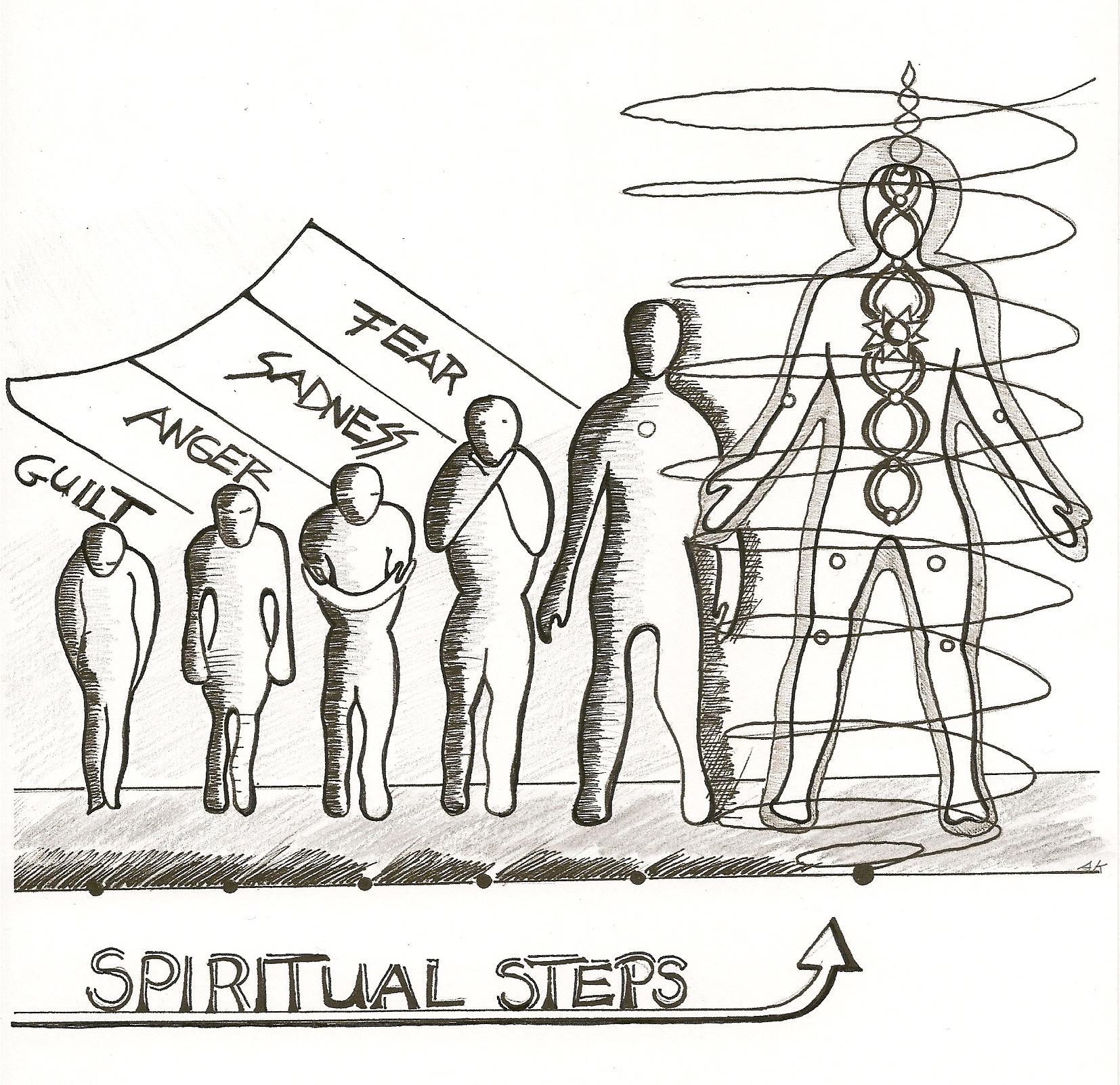
Illustration by Andrea Kurucz, selected as part of a gallery of drawings for Defrag your Soul.
Extended extract from a talk I gave to the National Federation of Spiritual Healers, on Saturday 12 May 2012, in central London. The talk contains some topics from my book, Defrag your Soul, due for publication in Summer of 2012.
Parts of the talk include:
- Beyond NLP
- What is your purpose in life?
- Duality
- How do you take spiritual steps on your journey within? How do you know you’ve taken them?
- The Etheric Body aka The Vital Body
- The links between the Etheric Body and Health
- The path to magic
Shine on…!
/|\
Paul C Burr
Follow @paulburr
The Original Meaning of Valentine’s Day
Posted by Doctapaul in Healing, Life's Changes, Love, Personal, Poetry, Self Development, Soundbytes of Wisdom, Training & Development, Uncategorized, Visions and Dreams on February 14, 2012
The ancients celebrated Valentine’s Day to acknowledge the wakening of the seed in hu-man. Deep within the ground, unable to see the light (above the surface) ahead, surrounded in darkness, the seed commits to its journey to the light of summer.

Image sourced from totaltrinity.wordpress.com
Valentine’s Day
Only Arthur, borne of truth,
Could release the sword from the stone.
Find your truth, release light into your darkness.
Glory lies in the once-shadows now lit.
/|\
Commit to your journey;
to break through the surface.
Allow your past to drop away.
Focus ahead, now.
Truth beckons.
/|\
Declare your intent!
Love, for Arthur.
Love, for God.
Love, the journey.
Love, the Light.
Shine on…!
/|\
Paul C Burr
Follow @paulburr
Unconscious Attracts…
Posted by Doctapaul in Coaching, Healing, Leadership, Life's Changes, Love, Personal, Pitfalls I've Fallen Into, Quirky Ideas, Relationships, Self Development, Selling, Soundbytes of Wisdom, Training & Development on January 18, 2012
 With so many changes in the world around us, tis vital to focus on that which you feel you can control and influence:- namely yourself and those in your immediate sphere.
Image from Crystalinks
You may not be able to influence the chaos but You can control how You respond to it. Feelings of anger, hurt, guilt and fear move from your conscious to your subconscious and then you project them outwards subliminally.
People see your “armoured shield” not the truth within. People are less attracted to an armoured tank than the beauty of love and truth. As a tank, your influence and effective communication is thus limited, if not futile.
So what is this armour? It manifests itself in the form of guilt, anger, sadness but most of all fear. The four seeds of karma. You cannot hide but you can get lost.
If you inebriate yourself from your negative feelings, you are in conscious denial. This does not work.
If you embrace your negative feelings, you restrict yourself from releasing them. For example, you may work long hours and completely commit yourself to avoiding failure. No matter how successful you are at avoiding that which you fear, you never release the fear.
Notice, I say “release the fear,” not “defeat it.” It takes courage to defeat fear, but it takes more courage to release it. Warriors defeat fear, alchemists release it. And in doing so they achieve fearlessness – which is not about bravery; it’s about wisdom.
On the far side of fear lies wisdom.
Release the four seeds of karma (guilt, anger, sadness and fear) and you…..
Shine on…!
/|\
Paul C Burr
Follow @paulburr
Steve Jobs
Posted by Doctapaul in Business, Coaching, Leadership, Quirky Ideas, Soundbytes of Wisdom, Training & Development on October 6, 2011
Image sourced from realmagic.com
“Innovation has nothing to do with how many R&D dollars you have. When Apple came up with the Mac, IBM was spending at least 100 times more on R&D. It’s not about money. It’s about the people you have, how you’re led, and how much you get it.”
Steve Jobs
Image sourced from
Shine on…!
/|\
Paul C Burr
Follow @paulburr

Fearless versus “Fearlessness” – the difference between courage and wisdom
Posted by Doctapaul in Coaching, Healing, Leadership, Life's Changes, Love, Personal, Relationships, Self Development, Soundbytes of Wisdom, Training & Development on September 27, 2011
 Should we ignore, or remain in denial about adverse situations or issues, we learn little if anything at all. The situations fester and pester more and more. We feel more pain or hurt. Should we continue to isolate ourselves from our feelings of hurt about what’s going on, we isolate ourselves from love, joy and fulfillment as well. This might need some explanation.
Image sourced from The Hero Construction Company
We can’t learn if something is wet or not if we don’t know what not-wet, i.e. dry, is. Likewise, we are unable to be selective when we detach ourselves from negative emotions. Should we detach ourselves from sadness, we detach ourselves from not sadness, i.e. joy.
I recall when a relationship, I was in, broke up, not too long ago. I took myself to the pub at night, to inebriate myself from the fear and sadness of spending lonely evenings on my own. It took me 9 months before I readied myself to acknowledge the sadness, fear and start to move on life.
So here’s the curious dichotomy: when we ignore or deny fear, we deny not-fear – i.e. courage.
And it takes courage to deal with inner issues. In fact, all issues are inner issues. (When the relationship ended we both had issues to resolve but they were different issues.She had hers. I had mine. They were both proprietary.) The more courage we demonstrate to ourselves to deal with our inner issues the more we learn about them.
And when we learn more about a subject, we become wiser, we become expert and eventually we become a master. Not only are we a master at what’s going on, we become a master over our fears. We don’t hide from, or deny, them. We manage our fears. We control them. We become warriors. We become heroes. To some people, this ends the journey (“Hail, the all conquering hero!”). It does not. It ends a significant part of the journey and starts the next.
When we acknowledge our fear and gain mastery over it – we start to experience the stillness or void from which we base our actions. We start to realise that the issue, we faced, was attracted by and to our fear. We brought the issue, perhaps unknowingly and albeit unwantedly, on ourselves. The issue brought the fear to the surface so that we can erase that fear and evolve to the good.This is a fundamental rule to the game of life. (It might even be the only rule. I’m still working that one out.)
When the fear is fully out in the open in front of us, noone else,we see through it. We wise up to the habits and patterns inside of us that manifest that fear. We realise that those habits and patterns are only habits and patterns – and nothing more. They are not reality but responses we took on, usually in our early childhood, to adverse situations. And when we see their illusory nature, they disappear and so does the fear.
We begin to realise we had nothing to fear in the first place. At this stage we are not fearless, instead we experience fearlessness. We have transmuted our fearless state of mind into fearlessness.
The warrior or hero does not ignore or deny, but manages and controls, their fear. The master or magician, through the wisdom from insight, dissolves fear. Magicians are not brave. They have no need to be. They know fear for what it is – a very real-like illusion.
Fearlessness is a symptom of having achieved a spiritual step on our road to enlightenment. Only two types of people experience fearlessness – masters and fools.
When we become a master at one stage of our journey we instantly become a fool (or totally uninitiated) in the next stage. We become both master and fool at the same time.
We experience the two purposes of fearlessness:
- It tells us we’ve achieved mastery at one level
- It gives us the encouragement to tackle the next stage in our development.
Such is the computer game called “Life” – until we take the last step, of course.
/|\
Shine on…!
Paul C Burr
Follow @paulburr
Fear Attracts Fear – Case Study
Posted by Doctapaul in Business, Coaching, Healing, Personal, Self Development, Selling, Training & Development on August 19, 2011

I coached an experienced salesperson who had fallen on hard times. Sales were down.
Like all good salespeople, he worked extra hard, and made as many sales calls as he could. He crossed all the t’s and dotted all the i’s in abundant call reports, to demonstrate his commitment and loyalty to his bosses. Alas, all to no avail.
Image from How Stuff Works
Like most of us (I include myself) it was easy to blame the economy………………
I asked what was driving him. Back came the response “Well I’m behind in my numbers and I want to catch up. I don’t want to lose my job!”
I asked a series of questions:
Q: “So fear drives your actions?”
A:“Yeh, I’ve got a wife and kids to support” came the answer.
Q: “To what extent do your friends and colleagues share your fear?”
A:“Quite a few, it’s time like this you find out who your friends are.”
Q: “To what extent do your existing customers share in your fear?”
A: “Yeh, a few have intimated that I’m trying too hard and come across as more pushy than usual. They are a bit apprehensive about me.”
Q: “And what of new customers and prospects?”
A: “Yes again, everybody I meet seems fearful to do anything right now, even when the business case is clear cut.”
So what’s going on here? I’ve coached many people in this predicament. Here’s what I’ve seen, time and again.
What drives us, we attract. Fear attracts fear.
So in the above client’s case, the coaching focused on tools to switch out fear and replace it with what the client wanted instead: “creative confidence”.
Within weeks, despite an ailing economy, the client’s sales figures went from poor, to fair, to good, to very good. He got back on track.
Ω
Shine on…!
Paul C Burr
Follow @paulburr
More Sales from Less Waste.
Posted by Doctapaul in Business, Leadership, Marketing, Selling, Training & Development on August 19, 2011
I saw a definition of the word creativity recently. It went something like “linking two things together for the first time”.
I got a message from Edward de Bono. He encouraged me, to think of creativity as more than selling new things, into a new market, incurring risk (against the grain of the current economic climate). But better still to use creativity to perhaps minimise risk and cut costs. This got me thinking.
“How might we minimise risk, cut costs and increase sales?”
I proceeded to think about the role the various functions or departments play in large corporations. What is it that Marketing, Training and Development, Sales Operations (sometimes called Sales Enablement) do? What do they all try to achieve?
A simple answer could be to get a decision-making customer (the information they need) to make a favourable decision.
Each department looks out from their pigeonhole and does their bit in getting the customer’s favourable decision. The more enlightened departments work in harmony to achieve the same end. Alas, this is a rarity…..
….. because most people still look at the function of their work inside-out….. “What outputs do I create, in accord with my job specification?” For example: a flyer, a campaign, a training event. What they often don’t do is measure the ultimate goal: favourable customer decisions. Instead of looking outside-in, they look inside-out. So the sum of the parts is never the whole.
So how would it be if we merged departments: Sales Training and Development, Marketing and Sales Operations/Enablement?
How about if we created a single department called: “Getting Favourable Decisions”.
(Or something less obvious, like “Customer Enablement” for those organisations whose culture has not yet migrated to the Aquarian Age of meaningful information.)
There is an old phrase: “50% of our marketing is valuable and 50% is waste. The trouble is, which 50% is which?”
Luckily for me, I got to analyse a vast amount of data. The utilisation data of a large global IT company’s marketing materials, deposited into a single digital repository. It tracks which materials are used, by whom, where, when, and for how long. The statement “50% waste” proved to be an understatement. The data revealed it was 85%, i.e. only 15% of the material was read by anybody outside marketing i.e. sales and customers.
Likewise I’ve spoken to many sales trainers about knowledge retention. They typically reckon that when people walk away from a training course, they retain 15% of the knowledge and wisdom imparted. That’s about the going rate.
So curiously enough this number 85% crops up again. 85% of the marketing material isn’t being used, 85% of the wisdom imparted is not being retained.
So how about creating a “zero-retention” application? An application that provides on-the-job information, wisdom, knowledge, learning, call it what you will. It gives you what you want, where you want it, when you want it. It’s concise, understandable, and is already customer ready. (No more time consuming training courses, no more pedantry e-learning.)
We merge, into one repository, all the materials we need, to give customers the right information, in the right sequence, to make a favourable decision. We provide this through one single department. We merge Sales Training & Development, Marketing and Sales Operations/Enablement into one. We reduce management overheads, courses and waste (by 85%?).
Your customers and salespeople engage using (the same) articulate materials, media, dialogues, analyses, questions and messages. They all sing from the same song sheet.
Sales go up. Selling cycles shorten. More sales from less waste.
p.s. Now you know what to do. Should you want to know more on how? Get in touch :).
Ω
Shine on…!
Paul C Burr
Follow @paulburr
The Executive’s Challenge: Make Transitions Quickly
Posted by Doctapaul in Business, Coaching, Leadership, Training & Development on August 19, 2011
I coach high flying, low flying, delinquent (and some just doing ok) executives. All do the best they know how.
When we meet, I often ask the following questions:
• How much of your time do you spend managing this month’s financial numbers – and how much on where you want to be?
• To what extent are you achieving what you set out to achieve? (Test anyone who says “more than 70%”.)
• How fast are your customers’ expectations changing?
• How fast is your competition?
These lead to one question they all have in common…..
How can I make the next transition fast?”
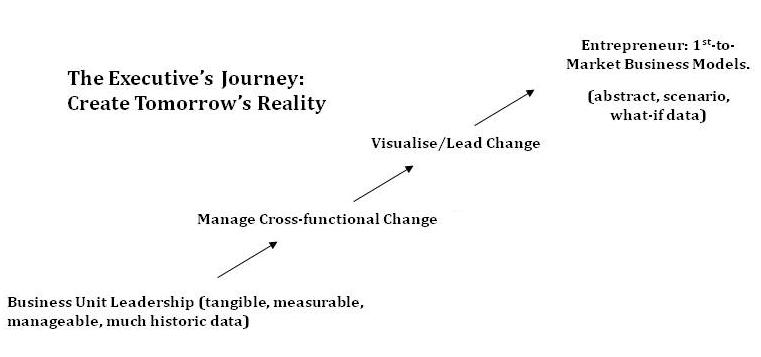
3 Transitions: from Strategic Business Unit Manager to….
Transition 1: Manage Cross Functional Change, to….
Transition 2: Visualise/Lead Change to….
Transition 3: Innovate Change: 1st to market business models, beyond “the edge of the envelope” (eg the next “Google”, Web 4.0)
The Business Unit Manager’s (budding executive) typical, environmental characteristics:
• Known ie tangible
• Current: this month, quarter, year
• Has much historic and comparative data
• And thus considered manageable
Contrast the above list with Transition 3:
• Unknown
• Little or no data. Historic data of limited value.
• Future paced: Next year, 3-5 years, 100 years?
• Abstract, conceptual
So many of the personal strategies the executive used to get to “base camp” will hold her/him back. Indeed, as their positional power grows, should they continue with the same behaviours, they drive everyone nuts. “Counting the beans in the bag: by size, geography, colour (or whatever category dreamed of) does not make more beans”
What happens? (How might coaching be relevant?)
Tis all about Relationships, Relationships, Relationships….
At a Personal Level:
• A change in context; from say, a promotion (or a move into another part of the organisation), the executive finds that the personal strategies that have underpinned their success, in their careers so far, are no longer as effective.
• With each career transition; to forge new relationships in a new context fast (and existing relationships that also change) requires more flexible relationship strategies and mindset.
• It’s also about helping the executive to find out and let go of what needs to be let go of.
• There may be more/too much data to analyse, or no data. In either case there is less time. So it’s about helping the executive to create personal strategies that are effective when faced with the unknown, missing data, even the abstract.
• To summarise, I coach to get the executive to figure out what to do more of, what to do less of, what to do differently.
• It’s also about the commitment and flexible mindset required to step outside the comfort zone that has enabled the success in their career to date – and even more vital in the next level of impact.
At higher Strategic Levels
(any migration along the continuum, from: Business Unit Leader–>Manage Change–>Lead/Visualise Change–>1st to Market Business Models)
• As their network of influence spreads, the executive’s emphasis for influence transcends from personal to strategic. Despite positional authority, the executive has less face to face time “per person” whilst they visualise and lead change, as well as manage issues as they crop up.
• Two things thus become more important.
1. The success of the executive strategy depends upon on the emotional journey (strategic buy-in or resistance) it receives. So it’s about mapping and future pacing strategy, to foresee emotional blocks, leaks, politics and value shifts required, to make it happen. The logic and process for change adapts to the least path of resistance.
2. The success of the executive is a function of their “Strategic Identity” within the extended organisation. To what extent do their seniors, peers, direct and indirect reports put trust in their integrity and capability. And how does this “trust” underpin their “Strategic Identity”. Is the “Strategic Identity” effective within the current and desired corporate cultures espoused?
• Advanced Influencing: Can the executive deploy advanced influencing techniques, by being at their peak in every meeting? “Yes!”
• And beyond? Is there a space where the executive generates strategies to influence people, who at first do not wish to be influenced (because influencing everyone else then becomes relatively easy)? Once again the answer is “Yes!”
• Distinguishing Traits and Characteristics: I spent the last 10 years studying people who deal successfully with senior executives. This work consists of 100’s of interviews and workshops, around the world, for a number of major organisations including IBM and Xerox. The research points to 7 Key Traits or Characteristics. By definition, traits are nurtured (ie coached) not taught.
To conclude….
Should you reflect, you will see that the transitions happen in everyday life too.
1. We run our own lives as a business unit, day to day. We hopefully balance our bank account every month.
2. Every now and then we have some change passed on to us to manage (e.g. a change in tax laws, a pay rise).
3. Sometimes we visualize and lead change (e.g. we get married/divorce).
4. There are other times we may choose to completely reinvent ourselves (e.g. a new career).
So, conceptually, Executive Coaching is not a million miles away from everyday life. What differs is the context, and complexity of dealing with a vast network of people, over whom we have no direct control.
Executive Coaching needs to address our Strategic Identity as well as the Personal. It needs to address the flow of energy we put into our network of influence, and what we take out.
Ω
Shine on…!
Paul C Burr
Follow @paulburr
4 Warning Signs that Tell You “You’re not ready!”
Posted by Doctapaul in Business, Healing, Leadership, Life's Changes, Personal, Relationships, Self Development, Training & Development on August 18, 2011

x 4
Can you recall a time when you set off on a venture and ignored or didn’t spot early warning signs that things were probably not going to go to plan? Those things are much easier to see in hindsight when “the milk has been spilt.” At the outset, our emotional attachment to the outcome is high. Those emotions however can cloud our vision of what’s possibly about to go awry. We head down the path to disappointment. We can avoid the path to disappointment and setback, when we can read the “road-signs”.
Four warning signs that point to pending setback and disappointment (in a relationship, in business, in everyday life):
- You get upset easily; means your pride is hurt. When you get emotional quickly and easily, you give your power to those you get upset with. You are clouded with emotion. You cannot see out what to do. Others cannot see in. You isolate yourself.
- Less power leads to low self esteem. You don’t feel good about yourself. This leads to fear.
- Fear of further upset and isolation: in extreme cases you despair and turn to others and do their bidding – in order to maintain some form of connection. This is not love or friendship. It is….
- Mind control: someone else has you under their thumb. This is not love. It’s manipulation. You have no way out, until you find the courage to get out from under.
So we can start by acknowledging our vulnerabilities. Which means neither embrace or deny them. Instead learn from them. Accept them for what they are…. head trash that needs dealing with.
We can go it alone – but I’ve found solitude and contemplation takes a wee bit too long for me. Instead I seek help… either through a group or an “energy healer”.
When you ready yourself to learn, your teacher will appear -and vice versa.
And should you choose to do nothing about it? Prepare yourself.
Because…. ( a definition for not taking responsibility)
“When the rocket is lit, your backside will appear.”
Ω
Shine on…!
Paul C Burr
Follow @paulburr
4 Killer Strategies to Boost your Sales
Posted by Doctapaul in Business, Coaching, Leadership, Selling, Training & Development on August 18, 2011

Killer Strategy #1
 Coach Top Performers: increase your top people’s contribution by 30% (and maybe increase your total company sales by >20%)
My research over the last 20 years has found that top performers demonstrate 7 key traits or characteristics (eg curiosity: eager to learn). Top performers love to be coached, to go (not think!) outside of their comfort zones. They yearn to discover what lies above and beyond their limits of success (all-be-they high already).
I see top salespeople, whom I coach, increase their sales run rates by 30%, in a matter of weeks. For those who really trust themselves and commit to the journey, performance goes up several fold.
_________________________________________________
2 Case Studies:
- Account Director (now a Vice President): Responsible for renegotiating a £50M pa contract within 9 months. The client achieved the £50M target within 11 weeks from commencement of the coaching programme.
- Regional Manager (now a Senior Vice President): used coaching methodologies to prepare his team for a new business-services sales campaign with an Australian bank. The team won a pilot worth around $100K in the UK. Our client flew to Australia to extend the bid. He then steered the local sales team to win further contracts……“I won the big one (worth £15M!) for the Australian bank I was after….. my life has changed quite a bit (for the better) and 80% due to your help”
_________________________________________________
Lever your company’s sales revenue. The top 20% of your salespeople probably bring in 80% of your revenue. Measure, if you can, the proportion, they contribute, to your profit line. I have clients who were staggered at the results.
You can now imagine what happens to your bottom line when your top performers raise their game by 30% and more. And, 0rganisational beliefs (about what’s achievable) get smashed. Others follow. But how fast? And can they keep up the pace?
So what about the remaining 80%?
Killer Strategy #2
 Raise Every Salesperson’s Results: model and spread your top performers’ traits and behaviours to everyone else

Sales effectiveness is a function of motivation, confidence, competence and curiosity.
Effectiveness = Motivation x Confidence x Competence x Curiosity
or…
E = MC3
(No longer a Theory of Relativity, nor rocket science, get everyone winning!)
So the objective is to raise everyone’s:
- Motivation: better yourself, seek wisdom, explore below the surface, relate to people and situations, analyse facts, follow process
- Confidence (as opposed to arrogance) know, execute: when to listen (ask), when to learn (bide time) and when to advocate (articulate)
- Competence and knowledge in 4 verbs, to: Connect, Inspire, Prove and Proceed
- Curiosity (to explore below the surface) about: selling, the customer, the customer’s industry, self, technology, your company, the world, and beyond….
This is how top performers come across and do things differently to average performers?
My personal research goes back nigh on 20 years. My studies include cross industry interviews and workshops with hundreds of salespeople, sales managers, directors, consultants and customers around the world.
My purpose here, is not to tell you how to do this. My purpose is to tell you what needs to happen.
Case Study: A pan Europe, Middle East and Africa (EMEA) survey, by a Top 5 Global IT Firm, reveals a boost in sales millions of dollars.
- UK, Regional Business Development Manager: “Sales are up because 30% more Account Managers are going out and selling solutions that otherwise wouldn’t have.
- “Middle East and Africa: Within 6 months of the launch, sales surpass $2.5M, in a region where hitherto, no Account Managers had been selling these solutions proactively.
- Q: “Score out of 10, how much has the approach contributed to the $2.5M revenue sum?”
- A: MEA Regional Business Development Manager “Contribution to sales? I’d say more than 8 out of 10.
- “Scotland: Regional Channel Partner Manager: “I started in May. The subject matter was new to me. I hadn’t been on any courses. I shared your “transfer mechanism” with our Business Partners. They were impressed. It’s now July, I’ve displaced our competitor as Business Partner of Choice and just won the first piece business, worth over $100,000,, that competitors were due to win..”
Killer Strategy #3
 Increase the Effectiveness of Sales Leaders: Equip managers to lead others, outside their zones of comfort.
I coach managers (to coach others). Many have already been “trained in coaching”. Yet, they increase their personal productivity measurably (£).
Why?
Because, for most, “training” does not engage the manager sufficiently in the emotional and insightful journey to become a great coach:
I have found that “training” gives process.
Training alone doesn’t:
- Engage the emotional journey of moving into discomfort with a fresh mindset.
- Shift the mindset from being an expert (i.e. mentoring) to a non-expert (i.e. a co-explorer)
- Shift the mindset from being directive (eg “you need to do a,b and c!”) to non-directive.
- Nurture 7 key traits, common to both coach and a top performer.
- Get managers to realise that every coachee (at some level) mirrors their own imperfections
All the above are essential skills and learnings to coach well.
A study carried out by Olivero, Bane, & Kopeirnan in 1997 demonstrated an 88% increase in management productivity when coaching and training were interwoven as opposed to a 22.4 % increase when managers were placed on a management training programme.
Top 5 Global IT Company: European Sales Management Team, Public Sector, already “trained” as coaches.
MANAGER A:
“When I do follow the coaching process it works and it fails when I don’t”
“First two sessions were particularly useful. I would not have got through that month without the 2 List System. I am more effective in how I use my time and am more prepared for important meetings. SOS helps me synchronise with people. Using 2nd position has helped enormously. Coaching isn’t an individual session; it takes place over a period of time to get to a solution. It’s made me face some demons.”
MANAGER B:
“The Coaching Process gets an A* for managing poor performers. “
MANAGER C:
“It has helped me to explore new ideas and not get hung up if they don’t work. I took away the “Preparing for Key Meetings” from the workshop and used it – it’s brilliant. I understand the coaching tools and need to get myself organised to use them on a regular basis next year.”
MANAGER D:
“I am more rigorous in the analytical and process quadrants and it’s paid off.”
“I took the material from the workshop and applied it rigorously to coaching (underperformer) X. It’s not there yet but the mountain has moved.”
The managers achieved “Top Team” status aross Europe, in the year following the coaching.
Killer Strategy #4
 Lift Under-Achievers out of the Mire: Save them, your managers, and you, a lot of time and possibly grief!

What do you do with an underperformer?
- Sack them?
- Leave them alone?
- Manage as best you can?
- Invest in them?
Coach them. Why?
Corporate Sales Case Study: a highly rated salesperson was underachieving in her first year on quota. Within two months, from the start of the programme, the salesperson’s going rate of year-end target increased from 20% to 80%. Her results then went from strength to strength.
Quotation…. “I found the programme extremely beneficial: it grew my self-confidence and self-esteem tremendously, and allowed me to go and sell. I have both the ability and I have earned the right to do this. I also treat customers as human beings, realising that the best way to persuade someone to agree with you is to get on well with them. I am much more ruthless about agreeing to tasks outside the scope of my quota – unless it eventually benefits my quota in some way. I do nothing unless it progresses me closer towards meeting my targets. I am better respected amongst my peer group and managers, and I am assured of a successful career with solid progression!
Overall, I recommend this to anyone, so long as they are prepared to accept new ideas and alter their attitudes to certain ways of working.”
Sales Managers lose 26 days (5 weeks!) per year dealing with poor performers, source: “UK Managers Losing Twenty-six Days a Year to Poor Performers”, SHL GROUP plc, Business Series 2005.”
The UK’s “lost management days” figure is lower than the other regions studied apart from one. The UK figure is 7 days more than Sweden.
No coincidence: Sweden invests the most in getting people to competence. Source: “Getting the Edge in the New People Economy”, www.futurefoundation.net, Future Foundation and SHL Group plc.
Under-performers, when coached, take an emotional journey (similar to top performers) to step up to the next level. They rid themselves of sometimes deep-rooted, personal, blocks that hold them back. Sometimes, it only requires a simple shift: maybe just a reframe of their perspective. Mostly though, it involves something deeper.
I often find that training doesn’t go anywhere near these deep emotional blocks. Under-performers will not allow it to. They fear the consequences of exposing what holds them back, often unconsciously.
The irreplaceable value of coaching: from research undertaken (Trygve Roos, Mental Coaching 2002) to discover what really causes effective behavioural change. It proved that the most pervasive change happened when learners were trained in various excellent techniques, followed by personal coaching/interventions.
Corporate Sales Case Study: New to sales, and prior to coaching, an erstwhile consultant’s going rate was 40% of his year-end target. Within two months his going rate was 80% and he was looking to overachieve. We focused on sales campaigns to win new business in competitive accounts. He went on to win a contract from one of the campaigns worth about $1.5M, from a client whose spend up until the start of the campaign had been minimal.
Ω
Shine on…!
Paul C Burr
Follow @paulburr
Grabbing the attention of customers’ boardrooms – common sense, uncommonly applied
Posted by Doctapaul in Business, Leadership, Marketing, Selling, Training & Development on August 16, 2011
I was researching the value of Cloud Computing. It’s still relatively new in boardroom parlance.
IT Vendors, speak of several issues to sell new technologies and services (such as Cloud Computing) to customer executives.
“How do we get our message across and understood?”
“How do we get our young salespeople to make executive calls confidently?”
“How do we skill them up, or maybe equip them, to do so?”
“How do we motivate young salespeople, who by definition aren’t experts, to call on Marketing Directors, Finance Directors, and so on?
I’ve been working with a global IT supplier. When introducing new advanced (and world-class) technologies, they had a devil of a job to get their value message across, convey trust and inspire across to its customer executives, outside the IT function
Here are the issues they encountered:
1. Only a small number of salespeople knew how to generate trust, articulate value and inspire action with senior executives in “big clients”
2. The rest avoided selling the new technology because they didn’t know how to perform Action 1.
3. If customer executives aren’t even curious about the value you can bring to planning table, you don’t get invited” to dine” there.
Now if we apply all the above principles to the SME market and Indirect Channel Sales, the whole picture gets economically fraught. In this market space people no longer sell on price and brand – and haven’t done so for years. They sell what they know how to sell.
So how do you give anybody the motivation, confidence, competence and curiosity to go sell something that’s new to the customer and new to them as well? How do you maximize cross and up selling opportunities?
Answer: You make it easy for them (and the customer) and apply an Outside-In Selling Approach.
Sounds easy doesn’t it? And so it is. Why, oh why, don’t more sales organisations apply it?
Here lies Rub #1. IT Vendors are very interested (and rightly so) in how their technology works. Customer executives are interested in the value it brings, i.e. what it does, not how it does it. By and large, customers executives are not intrinsically interested in technology.
Thus the successful sales approach requires a shift in mindset, from Inside-Out to Outside-In. For a large organization to take it on, such a shift has to be sponsored from the top. Why?
Rub #2:The traditionalists in product training and marketing will say they can do it for themselves. Well, they can’t. Because it also requires a structured approach to how customer executives want to receive information. “Less is more”. Product enthusiasts want to say more about what they are proud of. Customer executives want less. About 85% less, if I were to guess. So it’s about having a structured approach to find out which 15% of your collateral can be transmuted to inspire customer action.
“A lot of people in our organisation have supreme knowledge about our technology and what it can do for the customer, Paul. The vast majority of them, alas, don’t know how to articulate it to a customer to inspire action.
Inspiration = Knowledge + Articulation (first to self, then to others)”
– Top performing salesperson in UK for a Top 10 Global IT vendor
I leave you with a thought. I’ve checked out quite a bit of IT and IS vendors’ collateral on Cloud Computing and the like. It’s written mainly Inside-Out i.e. feature/benefit. Which means the customer has to be interested in how it works first, to see its value.
Top selling these years is applied outside in.
Ω
Shine on…!
Paul C Burr
Follow @paulburr
Transmuting your Sales ‘Farmers’ into ‘Hunters’
Posted by Doctapaul in Business, Coaching, Selling, Training & Development on August 16, 2011
Since the current economic climate began, organizations have been downsizing, reshaping, restructuring, removing layers of management, centralizing, decentralizing… you name it. As conditions worsened the focus has gone from cutting costs to cash survival (+ cutting costs). I’ve observed that no-one has been harder hit than SME businesses where, even in good times, cashflow has always been a bit of a juggling act.
So we are now fours years on, this very August. Customers and vendors who get on stick through the mire. They’ve shared the pain. What’s next?
A few organizations I deal with are gearing themselves for growth. It would be nice if they could ‘farm’ that growth from existing clients. Maybe they can but they do not want to ignore the opportunities from ‘hunting’ for new clients nor be wholly dependent on the custom of existing ones.
They seek to transform themselves from Sales ‘Farmers’ into ‘Hunters’.
Here are some salient points about their journey.
- There are 18 benchmarked critical success factors an organization can invest in to become ‘winners’ in hunting for new business (“superbidders” win more than 3 out 4 major bids). More on this later.
- The F-to-H transition is more of an emotional journey than an intellectual one. It’s about making people motivated, confident and curious as well as competent. This starts by making selling (‘hunting’) as easy as possible.
- Recent years of restructuring of reporting lines and reshaping of business processes will no-doubt have been for good reason. A key question remains – what changes will customers have noticed in your people:
– More fire and enthusiasm?
– Nothing?
– Or sloping shoulders? - Winning over the hearts and minds of (especially remote) people comes down to making their lives easier. Again, for salespeople (who follow the path of least resistance) – it’s about ‘making selling easy’ so that they can hit their sales-targets from hunting as easy as (or easier than) they can from farming.
- Sales training in Industry, Function and Product areas will provide much of the intellectual content required but will probably have only a limited impact on all but the top 10-15% of your salesforce. Management reinforcement will help further to instill hunting practices. The research I’ve seen in this area points to single figure %age growth in sales from such training/coaching interventions. So I want to talk about 3 things that can take you well into double digit growth.
3 areas to consider should you want to go for double digit growth:
1. Benchmarking – only 4% of companies win more than 3 out of 4 major bids for new business
The largest research programme in the world into winning business (led by Prof. Colin Coulson-Thomas, Chairman of Cotoco Ltd [www.cotoco.com]. I declare my hand here. I’m a Non-exec Director.) has involved over 2,500 companies. This large sample size includes companies of widely differing performance in Winning Business. Overall the results are consistent industry to industry – and across sizes of organisations.
Key Points:
• 18 Critical Success Factors (CSFs) to winning major bids
• The top quartile: “Superbidders” win more than 3 out 4 major bids
• “Superbidders” make up less than 4% of the total population
• “Superbidders” only consider themselves to be “very effective” in 8-9 out 18 CSFs. There is plenty of headroom.
• Largest number of organisations in quartile: the median is between 1:2 and 1:3 win ratios.
• Organisations in the median or lower quartile consider themselves to be very effective in only a small number of CSFs.
The top 3 (CSFs) of the 18 differentiators are:
- Understanding the value/benefits customers expect to gain from your products/services
- Understanding the cost of ownership issues that impact customers’ decisions about your product or service
- Establishing the superiority of your products or services over those of competitors
Organisations that spread themselves too thinly don’t catch up with the winners. I find that most organizations (I introduce this benchmark to) are already tackling a broad range of the CSFs. They do not realize that improving the CSFs you are very effective in from say 2-3 to 4-5 will have a huge impact on your win rate. So it’s about knowing the vital few to invest in first.
The benchmark informs you which CSFs to go for, to get the best RoI in winning major bids.
2. E-quipping every salesperson to engage with new C-Level clients the way top performers do – and save on your face to face training costs
This approach to enabling Customer Executive (C-Level) Engagement has been used by global companies like Cisco as well as SMEs for a number of years.
Having asked the right questions and done their research beforehand, we find that top performers engage with C-Level clients far more effectively because they use compelling evidence and messages to:
- Underpin the trustworthiness of your company.
- Raise your customer executives’ curiosity to investigate the broad range of services that your company can provide
- Make it easy for regular (non C-Level) customer contacts to convey, to their own peers and senior management (that your salespeople might not get to meet), the superiority that your company has to offer.
E-quipping (as opposed to the drudgery of e-learning) takes minutes. It provides the opportunity to cut out the high costs of face to face training. This can be a huge expense saving for global companies. It also means less time away from the field for your salespeople.
3. Coaching top sales performers to make the emotional breakthroughs to increase their sales by 30%+
And what about your existing top performers? How do you take them up and beyond their current levels of performance? They are already setting your company’s benchmark for what’s achievable – are they not?
The good news is that top performers are always curious about how to improve themselves. In my experience, good in-house management coaching will improve their performance by no more than say 5-10%. Going beyond (increasing their sales by 20-30% and beyond) requires coaching which (and an experienced coach who) will take them outside their comfort zones. For the journey to 30%+ is filled with emotional blocks: limiting beliefs about themselves, their client relationships and the tasks in hand. If it were purely an intellectual journey (these people are smart) they would be there already. The experienced coach gets them to dissolve these emotional blocks. And when they commit themselves to move beyond, their sales performance escalates.
Ω
Shine on…!
Paul C Burr
Follow @paulburr
How do you keep salespeople up to date?
Posted by Doctapaul in Business, Selling, Training & Development on August 16, 2011
Imagine you’re in corporate sales. You have 400+ (I’ve been quoted this) items in your email and your in-mail grows by the day. What should you read? Can’t decide? Take a day off from selling or delete them all?
Imagine you have a portfolio of say 20 products and services to sell. How do you keep up to date with what is important and relevant? You can only assimilate a tiny fraction of what is available – but is it the right fraction? How would you know? How would the people sending that information know?
Now imagine you have a portfolio of over 600 products and services. What chance, of keeping up to date, have you now?
A smarter planet means everything connects: across brands,across industries, across technologies… across everything. What does this mean to the customer? And the customer could be anybody.
Now you’re a sales director.
How do enable your sales people to have the breadth of conversation with a wide range of people (architects, hospital managers, mayors, CEOs, business owners etc. rather than CIOs/technical people).
You are no longer dealing with a bucket full of information but an ocean full.
How do you enable selling across a huge range of products and services?
Throwing e-learning at it will not work – there is just too much stuff.
Each sales person needs to be like a general practitioner – which means the patient that comes through the door may have one of thousands of ailments. How can an individual sales person be an expert in all of these at the same time?
An Answer:
Build ‘an expert on everybody’s shoulder’ to whisper guidance in their ear. The ‘expert’ will equip each salesperson with everything they need to generate trust, articulate value and inspire action with senior customer executives. Once they get the ball rolling for a particular opportunity then, hopefully, it’s business as usual for them.
Salespeople want information but….
3 critical factors I’ve observed about your typical salesperson:
- Short attention span
- Wants everything on a plate – won’t work at it
- Wants the relevant up to date information in seconds – not minutes, hours or days
And:
- “A common weakness: most sales support material (I come across) is designed “Inside-Out”, not from the customer’s perspective. Top performers take this material, massage it and whiteboard a powerful “Outside-In” story. This is what you capture and disseminate. (“Inside-Out” collateral lists features and benefits. “Outside-In” focuses on value, trust and evidence)
- Content needs to be vetted by top and average performers, and technical experts, to ensure it is fit for purpose – i.e. will make selling easier.
- No module of information lasts more than 90 seconds.
- Everything needs to be at their fingertips
- The approach focuses initially on getting the customer to say “tell me more”. Then it makes it easy for the customer to say ‘Yes!’. The approach e-quips the salesperson for this precise purpose. E-quipping isn’t e-learning. (Warning: e-quipping is vastly misunderstood by the Training and Development community because they look at it as learning. They don’t get it.)
Good selling!
Ω
Shine on…!
Paul C Burr
Follow @paulburr
-
You are currently browsing the archives for the Training & Development category.

Share this page


How to Be a Friend of the Devil Within

Available from Amazon and major bookstores:
Quick Guide VII – A Top-notch, Sales-Relationships, Account Management Template

Available from Amazon and major bookstores:
Quick Guide VI – How to Sell Coaching

Available from Amazon and major bookstores:
For The Love of Lilith & How to Put Love into Practice (and Non-attach Yourself to It)

Available from Amazon and major bookstores:
Quick Guide V – How to Apply Mindfulness to Business Relationships

Available from Amazon and major bookstores:
The Mystique to the Game of Life (and Unrequited Love)

Available from Amazon and major bookstores:
Quick Guide IV – A Scorecard that Accounts for Mindfulness in Business

Available from Amazon and major bookstores:
Quick Guide III – How to Bridge the Pillars of Successful Business Relationships

Available from Amazon and major bookstores:
Quick Guide II: How to Spot, Mimic and Become a Top Salesperson

Available from Amazon and major bookstores:
Quick Guide: How Top Salespeople Sell
Available from Amazon and major bookstores:
Defrag your Soul

2012: a twist in the tail

Available from Amazon and major bookstores:
Learn to Love and Be Loved in Return

Available in USA and UK, in paperback and Kindle format
 ,
, 
 ,
,  &
& 
 &
& 
 ,
,
 &
&
 also
also
 ,
,  also
also
 ,
, also
also
 ,
, 


 Paul C Burr